Best Damascus Knife Sets with Magnetic Blocks (2026): Edge-Safe Luxury
Why hide 67 layers of exquisite Japanese folded steel inside dark wooden slots? Upright magnetic displays protect delicate 15-degree cutting edges from dulling slot friction, prevent mold growth, and turn your cutlery into functional kitchen art.
1. Zero Edge Friction
Traditional blocks rub against the cutting apex each time you insert or remove a knife, dulling the micro-bevel. Magnetic stands contact only the flat blade face.
2. 100% Hygienic & Mold-Free
Enclosed wooden slots trap residual moisture and airborne grease, breeding black mold. Open magnetic stands wipe completely clean in seconds.
3. Instant Blade Identification
Never guess which handle belongs to the Santoku vs the Chef's knife. The full Damascus blade topography and length are completely visible at a glance.
Top Magnetic Damascus Sets Compared
| Model | Price | DCI Score | Stand Material | Capacity | Core Steel | Best For |
|---|---|---|---|---|---|---|
| HexClad | $399 | 96/100 | Solid Walnut | 6 Knives | Japanese | Best Overall Pick 2026 |
| Dalstrong | $349 | 94/100 | Acacia Wood | 5 Knives | Japanese | Most Impressive Aesthetics & Power |
| Yoshihiro | $320 | 95/100 | Acacia Wood | 3 Knives | VG-10 | Chef's Gold Standard (Minimalist 3-Piece) |
In-Depth Reviews of Our Top Magnetic Picks
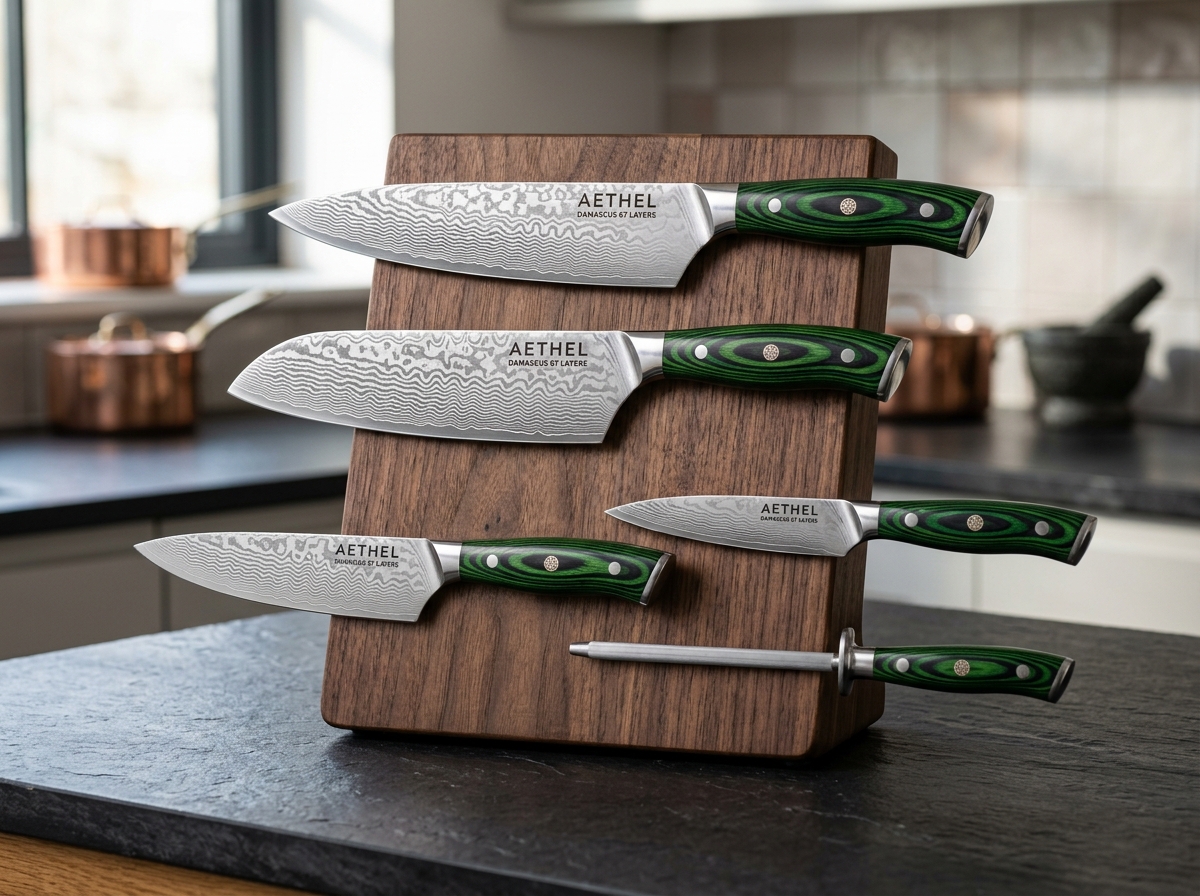
#1 HexClad Essential 6-Piece Japanese Damascus Steel Knife Set
The reigning benchmark for modern Damascus sets. Combining 67 layers of Japanese AUS-10V steel with an upright magnetic walnut display block that prevents blade micro-chipping.
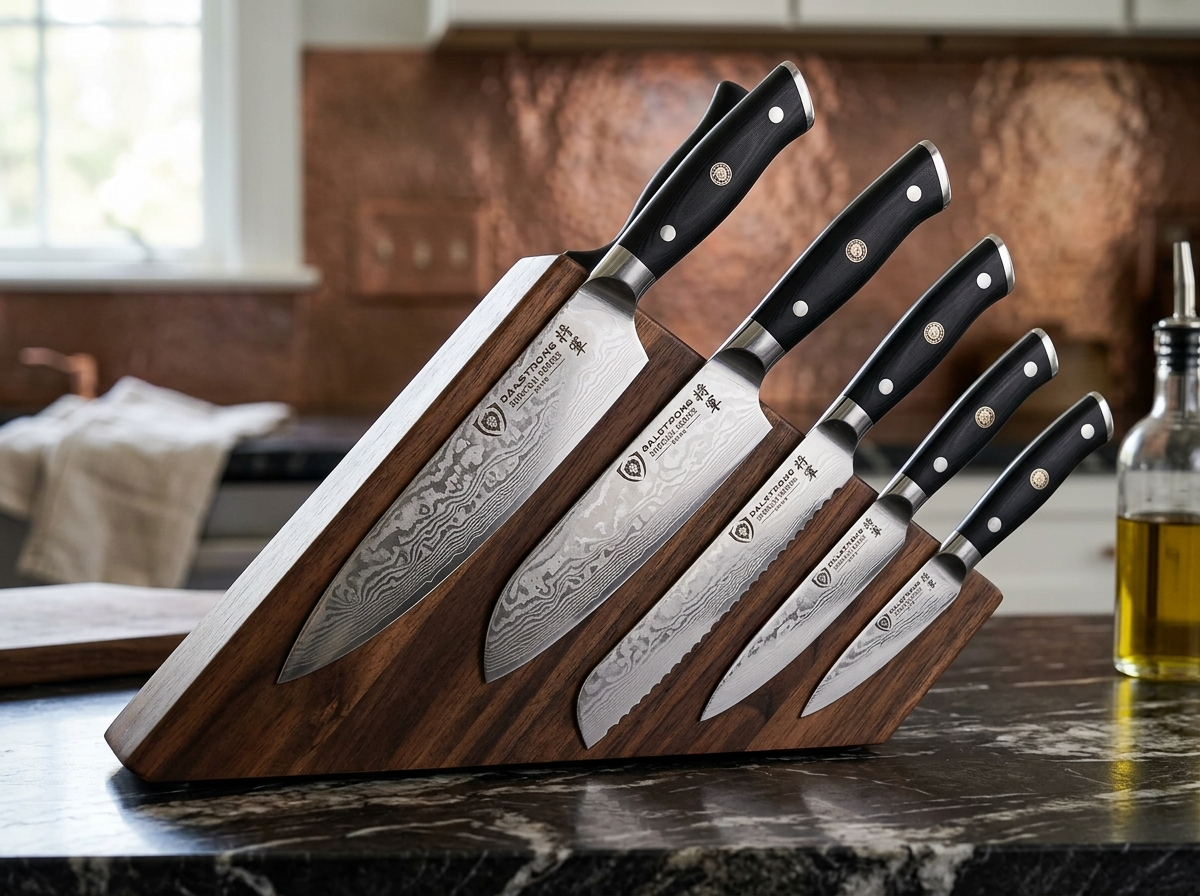
#2 Dalstrong Shogun Series ELITE 5-Piece Damascus Block Set
Built for chefs who demand eye-catching artistry with punishing performance. Features liquid nitrogen cryogenic tempering for unbeatable edge retention.
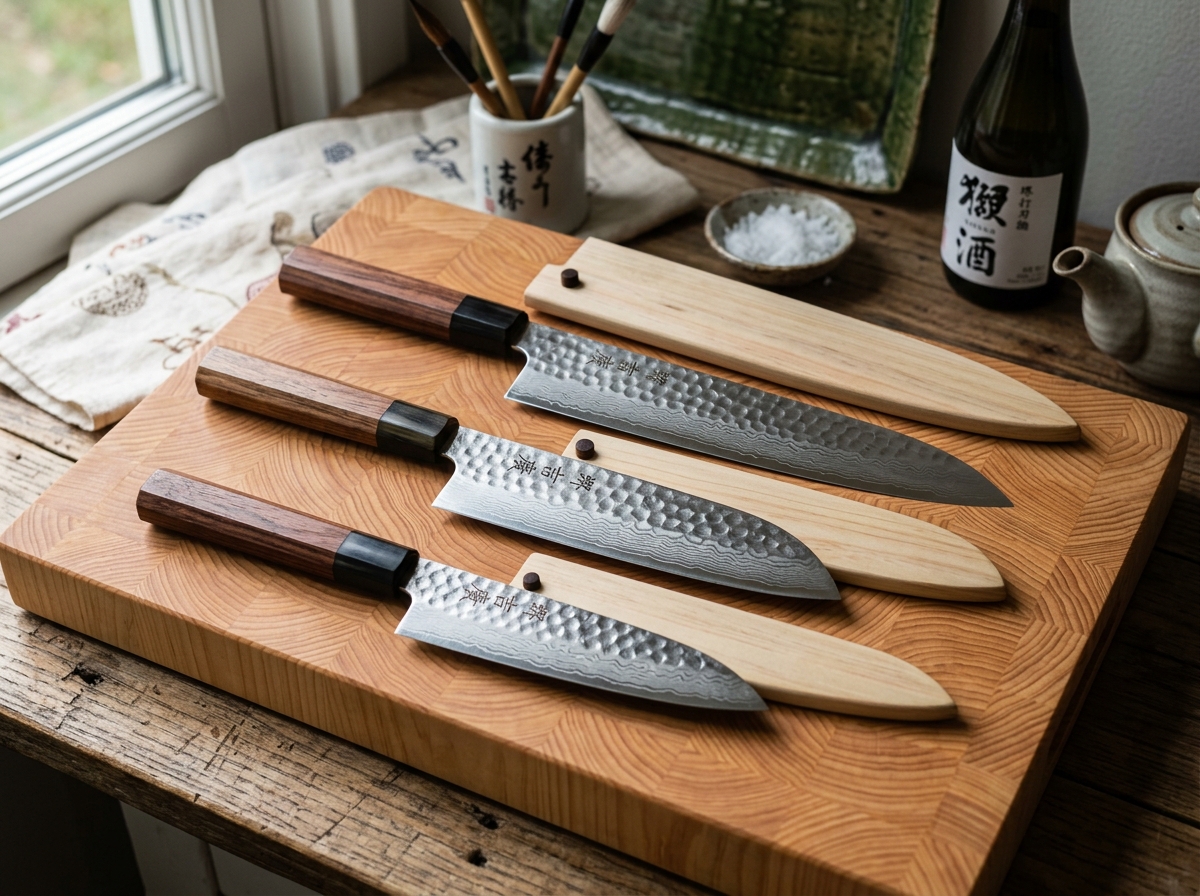
#3 Yoshihiro VG-10 46-Layer Hammered Damascus 3-Piece Executive Set
The culinary purist choice. 46 layers of Damascus capped with a hammered Tsuchime dimple finish that stops sliced potatoes and meats from sticking.
The Physics of Magnetic Knife Blocks: Why Slotted Blocks Ruin Damascus
Traditional slotted countertop knife blocks are the number one cause of premature edge dulling in home kitchens. Every time a knife is pulled from or pushed into a narrow wooden slot, the acute 15° cutting apex drags directly across abrasive wood fibers. Over 300 meals a year, this repetitive dragging friction rolls the microscopic cutting apex, requiring frequent aggressive re-sharpening that wears down your blade.
Furthermore, enclosed wooden slots are dark, unventilated cavities. If a knife is inserted with even a single droplet of moisture, the slot becomes a breeding ground for bacterial colonies and traps trapped humidity against the blade, inducing localized pitting corrosion along the Damascus acid-etched boundary layers.
Magnetic blocks secure knives entirely by their broad lateral blade faces. The ultra-fine cutting apex remains completely suspended in ambient open air, never touching wood, acrylic, or plastic. This extends edge retention by up to 300% compared to traditional slotted block storage.
Unlike bare metal magnetic wall strips that can scratch pattern-welded billets, premium magnetic blocks encase industrial rare-earth N52 neodymium magnets beneath a seamless veneer of natural walnut, acacia, or pakkawood (Mohs hardness 2.5–3.0), cushioning the Damascus steel (Mohs hardness 6.5–7.0) with zero scratching risk.
Neodymium Gauss Ratings & Cladding Magnetism
A frequent concern from prospective buyers is whether stainless Damascus knives will securely adhere to magnetic blocks. Japanese San Mai blades feature an AUS-10V or VG-10 central core wrapped in alternating layers of 410 and 430 stainless steels. These steels are ferritic and martensitic alloys containing abundant iron, providing strong magnetic permeability. Premium blocks calibrate their internal magnetic field between 900 and 1,200 Gauss at the wood surface. This provides approximately 3.8 to 5.2 lbs of lateral holding force—preventing heavy 8-inch chef knives from slipping downward while releasing effortlessly with a gentle wrist twist.
Countertop Hygiene & Visual Damascus Showcase
The Damascus acid-etching process creates stunning undulating visual waves across the steel: raindrop, twist, ladder, and feather patterns. Traditional blocks conceal 90% of this artisan artistry inside dark slots. Magnetic display blocks transform your cutlery into a functional work of culinary art while making hygiene inspection instantaneous—you can visually confirm every blade is spotless and bone-dry before resting it on the block.
Open-Air Storage Maintenance Schedule
Calculate exact mineral oil conditioning intervals for both your wooden magnetic stand and your Damascus steel blades with our interactive Care Scheduler.
Frequently Asked Questions
Do magnetic knife blocks scratch Damascus steel patterns?
No, provided the block features embedded internal neodymium magnets encased beneath a real wood veneer (such as walnut or acacia). Because the blade only contacts soft natural wood, the acid-etched Damascus pattern is completely protected from scratches.
Why are magnetic blocks better for Japanese Damascus knives?
Traditional slotted blocks scrape against the fine 15-degree cutting edge every time a knife is drawn or inserted, gradually rolling the delicate apex. Magnetic blocks hold blades by their broad flat face, keeping the sharp edge suspended in air with zero friction.
Are magnetic knife stands safe around children?
Quality magnetic blocks utilize industrial rare-earth neodymium magnets requiring 3 to 5 pounds of lateral pull to release. However, because blades remain visible, magnetic blocks should be placed against the kitchen backsplash out of reach of young children.
How do you safely remove a knife from a magnetic block?
Always peel the knife away by twisting the handle so the spine acts as a pivot, lifting the sharp cutting edge away from the wood surface first. Never pull the blade straight out or slide the sharp apex horizontally across the wood face.
Do magnetic blocks need mineral oil conditioning?
Yes. Natural acacia and walnut magnetic blocks should be rubbed with a light coat of food-grade mineral oil or beeswax board butter every 3 to 6 months to prevent the timber from drying, warping, or cracking under kitchen heating.